Saturday, June 20, 2015

In Search of Metro-Land

In November, my girlfriend introduced me to Metro-Land, a 1973 BBC documentary she'd watched two years prior in class while studying abroad in London. The film was written and narrated by John Betjeman, a onetime Poet Laureate of the UK and leading enthusiast of British railroads. It's a wonderful film populated by fascinating characters, and blessed with a unique and diverse soundtrack ostensibly curated by the author. The film has never been released in America, and is available only via Region 2 DVD or torrent; the soundtrack has never been released anywhere, and the quest to identify and acquire the music heard during the film served as a rare diversion while studying for Boards [1].

Music begins Metro-Land at center stage: the film begins with a sped-up montage documenting the length of a line on a Metropolitan Railway train starring the frantic music used to score it.


The tune is a rendition of Scott Joplin's standard "Tiger Rag," as performed by The Temperance Seven, who gained short-lived fame during the traditional jazz craze that swept England in the years immediately preceding the rise of The Beatles. To up the frantic factor, a 33⅓ rpm record was played at 45 rpm; it starts the show with a bang, and listening to the unaltered recording (below) shows it to have been an astute decision.


"Tiger Rag," along with other music used throughout Metro-Land, is identified in the screenplay included in the 1976 compendium The Best of Betjeman. (The entire book is a worthwhile selection of his poetry and prose; the third section comprises the script and is available for download as a PDF here.) In all, 14 recordings were selected for use in Metro-Land, outlined below. There are also four featured diegetic tracks: one choir performance of the Harrow School Song ("Forty Years On") and an organ medley played by Len Rawle in one of the film's most memorable sequences.


Of the 14 selections not performed onscreen, 10 or 11 [2] are directly identified in The Best of Betjeman. Five of these were released together in 2015 by Cherry Red Records as part of a fascinating collection. The compilation opens with the entirety of the Temperance Seven's first album, which itself began with "Tiger Rag"; the other tracks from Metro-Land included in the compilation are "Build a Little Home" by Roy Fox and His Band (recorded in 1934); "Masculine Women and Feminine Men" by The Savoy Havana Band (1926); "The Sunny Side of the Street" by Jack Hylton and His Orchestra (1930); and "Golfing Love" by Melville Gideon (1923).

Three others mentioned by name in the book are easily found for purchase today. The Osmonds' "Down by the Lazy River" and Bread's "Everything I Own" were both legitimate hits in 1972. The third song, also released in 1972, was "Neasden!" by William Rushton, a comedy record celebrating the dubious attractions of the titular, run-down-looking London suburb. It was originally released on Spark Records by the satire magazine Private Eye and has since found its way onto compilation albums. For its inclusion in Metro-Land, "Neasden!" was specially remixed from the original master tapes to highlight the lyrics, which producers felt had been "slightly overwhelmed" by the "rambunctious backing by 'The Ron Watford Sound'."

Four of the remaining six tracks are classical compositions. Two are directly named in The Best of Betjeman: "Civic Fanfare" by Edward Elgar and "Solemn Melody" by Walford Davies. An orchestral crescendo appears in the film and is identified in the script as "‘The Witch of Endor,’ ‘Le Roi David’ ‒ Honegger." The sequence is found in the twelfth movement of Arthur Honegger's Le roi David suite, entitled "Beschwörung der Hexe von Endor." The final classical piece was described in the script as "‘Double Concerti’ ‒ Handel." With the help of a stranger on Reddit, it's been identified as the first movement in Handel's Concerto a due cori No. 2. In all four cases, it's proved predictably difficult to identify the precise recording used in the film.

A similar challenge was presented by one of the remaining two pieces, identified in the script only as "‘Tit Willow’ ‒ Gilbert and Sullivan." Wikipedia revealed the song to be the 3rd-to-last number in The Mikado, which has been recorded innumerable times in a near-equal number of places. Luckily, an unusual arrangement was chosen for use in the film - entirely instrumental, including the usually-sung vocal line. A quick(ish) survey of the available recordings of "Tit Willow" on Spotify allowed me to positively identify the recording selected for use by Betjeman as the version performed by the Cyril Ornadel Orchestra. Few-to-no details on the recording seem to be available on the internet beyond the title and artist.

The final recording used in the film is identified in the script as "‘When the Daisy Opens her Eyes’ ‒ Albert Sandler." Not much else of the song exists - anywhere. "When the Daisy Opens her Eyes" was apparently composed by Haydn Wood, and trace references to the song appear on Google in prewar archive documents including copyright catalogs and social newsletters. Effectively all online references to the Sandler recording, however, are from copies of Metro-Land's Wikipedia article, citing the song's inclusion in the aforementioned script.

Not much exists on Sandler himself, either. A bare-bones life story was distributed in the 40s on the reverse of a trading card packaged with Wills's Cigarettes (right), and as time has elapsed, little has been added. By far his most extensive online biography is a 3 paragraph write-up by AllMusic's Bruce Eder, which aptly begins, "One would never know it from the neglect heaped on him since World War II, but violinist Albert Sandler was one of the more popular orchestra leaders in England during the period between the two world wars, and a leading name in the field of light classical music." Per Eder, Sandler was born in 1906 and died in 1948, and at his 1940s peak was a popular bandleader whose orchestra often appeared on BBC radio. For Sandler, "When the Daisy Opens Her Eyes" may have been an occasional setpiece, or perhaps even a staple as he led his bands through performance after performance in hotel ballrooms first in Eastbourne, and later in London. For me, it has become a White Whale.

Given that Metro-Land was released 25 years after Sandler's death, I can think of three possibilities for "When the Daisy Opens Her Eyes." First, The Best of Betjeman may have simply mistaken the title or artist of the song [3] (though I hope not). Second, the recording may have been made exclusively for radio broadcast. This would explain how hard it's been to find, and it's conceivable given that both Metro-Land and any radio performance of the song would have been made under the aegis of BBC. However, one of the few other references to both Albert Sandler and "When the Daisy Opens Her Eyes" to be found on the internet is from a 1950 radio guide to a now-repurposed Melbourne radio station [4], which was never affiliated with BBC and is therefore unlikely to have enjoyed access to BBC radio archives.

All of which leads me to guess that the song must have been recorded for release on record. So where is it? To date, I've come across four Albert Sandler compilations in person or on the internet, precisely zero of which include "When the Daisy Opens Her Eyes." By my best count, I've also come to recognize 80 records released during Sandler's lifetime on 78rpm shellac. This amounts to 160 tracks; 156 of these were released by Columbia Records [5], and again, zero of them are titled "When the Daisy Opens Her Eyes." I expect that the song was recorded for and released by Columbia. It would have been destined to one of the same two fates as other releases of its day. Some records sold well, and were produced in sufficient quantity and distributed sufficiently widely to ensure that some number survived to the modern day [6]. Others never took off, and became rarities out of proportion to more recent unpopular records, having been both (a) less able to coast on the strength of popular songs with which they were packaged and (b) released in a physical medium that shatters when handled even with indifference, much less neglect.

In that respect, assuming it ever existed, Sandler's "Daisy" resembles countless other pre-LP recordings released to an unreceptive audience; only its brief appearance in the background of a TV documentary saved it from complete obscurity. Somewhere out there, a viable copy of "When the Daisy Opens Her Eyes" may be sitting on a shelf, or precariously positioned in a box of dusty old crap in someone's Neasden attic. With any luck, it may survive and end up for sale on the internet; I'll keep my eyes on eBay just in case. Here's hoping for a happy ending.

* * *

[EDIT 4/28/2016: There was indeed a happy ending – details are here, and the song can be heard below.]

* * *


Music from Metro-Land

You can listen to the soundtrack below. Songs marked with an asterisk* are not included for reasons detailed above. "Tiger Rag" is included twice: first in a version digitally sped up to approximate the version included in Metro-Land, and again towards the end in its unaltered form. The complete medley of Haydn Wood compositions from which "When the Daisy Opens Her Eyes" was excerpted is included at the end. The complete list of songs heard in the film is as follows:

1)   Tiger Rag (The Temperance Seven)
2)   Build a Little Home (Roy Fox and His Band)
3)   When the Daisy Opens Her Eyes (Albert Sandler)
4)   Le roi David - 12. Beschwörung der Hexe von Endor (Arthur Honegger)*
5)   Neasden! (William Rushton)
6)   Civic Fanfare (Edward Elgar)*
7)   Solemn Melody (Walford Davies)*
8)   Masculine Women and Feminine Men (The Savoy Havana Band)
9)   The Sunny Side of the Street (Jack Hylton and His Orchestra)
10) Down by the Lazy River (The Osmonds)
11) Tit Willow (Cyril Ornadel Orchestra)
12) Golfing Love (Melville Gideon)
13) Concerto a due cori No. 2 - 1. Pomposo (Handel)*
14) Everything I Own (Bread)
15) Selection of Haydn Wood's Songs (Albert Sandler)


Wednesday, June 17, 2015

The View from the Top

My first baseball game took place on July 25, 1999 at Candlestick Park. It was a grand old stinkfest between the Reds and Giants, with then-future Giant Michael Tucker knocking in the winning run in a 13-inning 2-1 Reds victory. I can't point to my first Warriors game, but it would have taken place about the same year (give or take a few) and been every bit as ignominious. The Warriors of my early adolescence reliably won between 20 and 40 percent of their games per year. By 2000, I'd been following the team for long enough to be excited that Warrior legend Chris Mullin had resigned with the team, yet remained naive enough to believe he could play a hand in transforming a franchise not so much mired in perpetual crappiness as defined by it. And now, here we are: "the 2015 World Champion Golden State Warriors" is officially a factual descriptor, despite the franchise being only four seasons removed from starting Kwame Brown 3 distinct times.

Our recent Giants dynasty [1] holds a unique place in my heart. Giants radio broadcasts were an anchor for me when I was cast adrift after my vision failed, and the team that had already mattered more to me than any of the others suddenly meant much more than any of the others. By quirk of fate or otherwise, the team's fortunes subsequently mirrored my own, culminating in both cases in 2010 after years marked by struggle. The Franchise and I both had tough years in 2011 and 2013, and in both cases, as things turned around for me, the Giants found themselves making another charmed run through October. Each season, the roster changed and the team's identity evolved, yet through it all - and really, dating back to the drafting of Tim Lincecum and hiring of Bruce Bochy - it felt as though the ship was guided by a steady hand, just waiting for the pieces to fall back into place.

No words could ever have been further from the truth across the Bay. For a few years, my friends and I celebrated my birthday at Warriors games, each time understanding that odds were firmly against hanging around, much less winning. The early/mid-2000s saw the Warriors, 49ers, and Giants all enduring some of the worst years in their respective histories [2], each with little hope and even less direction for the future. Yet where the 49ers were (relatively) fresh off the strongest two decades in NFL history and the Giants played in a ballpark itself worth the price of admission, the Warriors housed their product - almost relentlessly mediocre since the Ford administration - in a trash can-shaped stadium whose ceiling obstructed views in the upper deck and whose parking lot took no less than an hour and a half to escape when the game was over. It was the perfect recipe for a fan experience no one could be excited about.

But man, should you have gone to a Warriors game. Taco Bell used to offer every fan in the stadium a free taco with show of ticket to a game in which the Warriors scored 100 points, a promotion that lasted for years on the strength of how infrequently anyone was able to call their bluff. You never would have known it sitting in that obstructed upper deck, invariably packed to the gills with fans whose screams would rattle that trash can's foundations with every Bimbo Coles free throw that pushed the team closer to that elusive .350 winning percentage. It never seemed to matter that nearly every move management ever made was wrong; no one stopped coming, or watching, or even talking themselves into the feverishly absurd notion that any of the franchise's bungled schemes could someday pay off.

And again, here we are in 2015, and the only one of my favorite teams I never in my heart of hearts believed (until three years ago) would ever pull it all together stands alone at the top of the heap. Part of me is basking in the afterglow: 27-year-old Steph Curry just reasonably (if remarkably) did with the best roster in basketball what 11-year-old me discovered 37-year-old Chris Mullin reasonably was unable to do with possibly the worst roster in basketball. This has, in other words, been a long time coming, and that in itself is cause for excitement. Another, probably older part of me, though, is marveling at the un-Warriorsy manner in which this feat was accomplished.

This championship lineup is the result of a note-perfect negotiation of roster building in modern sports, with irreplaceable parts having been culled by draft (Curry, Thompson, Barnes, Green, Ezeli), trade (Bogut, Lee), and free agency (Iguodala, Livingston, Speights, Barbosa). The coaching staff recognized and exacted the team's true potential, abandoning both Don Nelson's refusal to defend and Mark Jackson's indefensible unwillingness to liberate the league's most talented offense. A roster that is now [3] being heralded as a potential paradigm shifter in the evolution of the league was conceived, assembled, and managed to perfection by the same franchise which over the course of three consecutive years drafted Joe Smith over Kevin Garnett, Todd Fuller over Kobe Bryant, and Adonal Foyle over Tracy McGrady.

Since the modern-vintage Warriors' first playoff appearance in 2006-07, nearly everything has changed: even that magnificent trash can in which the Warriors still host their games won't be home for much longer. To outside observers - and occasionally, even to fans - the rise of this most successful incarnation has seemed sudden, and that would seem to fit best with the shot-in-the-dark mentality that's formed the core of this team's identity for most of the past four decades. Yet the actual assembly of this roster happened methodically, step by patient step, and still required a new coach and a huge vote of confidence in Klay Thompson to push the team over the edge.

I've followed the Warriors for nearly all of my conscious lifetime; I've won them championships in long-forgotten video games, and willfully purchased merchandise adorned with what I even then considered one of the worst logos in sports. They've provided some of my favorite memories, even as they made me wonder why nobody in the Bay Area - myself included - ever seemed to give up on them. In fact, as this recent run of success culminated in this recently concluded playoff run, I was surprised by how inevitable the long-in-waiting success felt. Only one aspect of this story has had me continuously shocked: that those sad sack Warriors could ever have quietly become the best-managed franchise in basketball.

This season was a joy to watch, as a student grateful for scant diversion, as a devotee of the game, and needless to say, as a fan whose dues were officially paid up at least a decade ago. It was also a reminder that patience - perhaps especially when unwarranted - can lead to surprises in the least expected of ways. There may be something to be said after all for waiting people out. The results can be electric.


Monday, May 5, 2014

An Explanation of Nick Drake's Official Discography

Nick Drake's enormous talent has been expounded upon in countless other places, as have his sad life story, the history of his official and bootlegged releases, and the value of exploring the far reaches of his recordings. What's far more difficult to find is a succinct explanation of precisely what material has seen official release, how many times, and where. This is what I intend to set out below for the benefit of anyone who might seek it out.

Tracks listed in bold are exclusive to the album under whose title they are listed.

Before his death in 1974, Drake recorded three note-perfect studio albums: Five Leaves Left, Bryter Layter, and Pink Moon. During his lifetime, an eponymous compilation album was also released, featuring only tracks from the first two studio albums. As of June 2015, there have been 9 posthumous releases. Of those nine, four - Fruit Tree, Heaven in a Wildflower, Way to Blue, and Tuckbox - do not feature any exclusive tracks. (These are discussed at the end of the post.) Details of the remaining five are as follows:

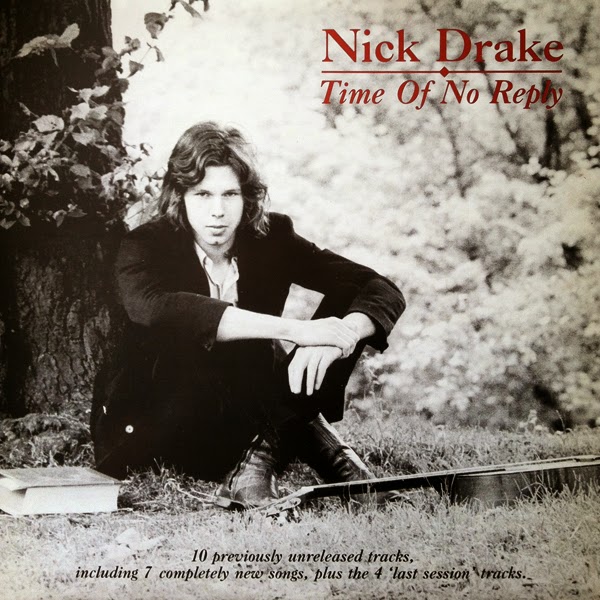
Time of No Reply was released in 1986, and is the only posthumous album of Nick Drake's to feature a full length album's worth of music that had never been officially released before. The majority of the album dates back to the Five Leaves Left sessions or before, including songs that didn't make the cut, demo versions of some that did, and an alternate arrangement of "Thoughts of Mary Jane." It then concludes with four of the five songs Drake recorded in his abortive 1974 recording session. ("Tow the Line" was not discovered on the reel until later, and therefore was not included.)

Made to Love Magic was released in 2004 and is the successor to Time of No Reply. It features 13 tracks instead of 14: gone are "Man in a Shed," "Fly," "Been Smoking Too Long," and "Strange Meeting II," in favor of demos of "River Man" and "Three Hours," plus the aforementioned "Tow the Line." All of the tracks are remastered, and the difference in sound quality is dramatic. Of the 10 tracks that overlap with Time of No Reply, only 5 are identical to the versions found on that album: "Joey," "Thoughts of Mary Jane," "Clothes of Sand," "Black Eyed Dog," and "Voices" (whose title has changed from "Voice from the Mountain"). Of the remaining tracks, "Rider on the Wheel" has received a new stereo mix, but is otherwise the same as the preceding version. "Magic" (again, a retitling of "I Was Made to Love Magic") and "Time of No Reply" have newly-recorded arrangements by Robert Kirby, written for the Five Leaves Left recording session but abandoned when those tracks were omitted from the debut album. The remaining two tracks, "Mayfair" and "Hanging on a Star," are alternate versions of those found on Time of No Reply.

Family Tree was released in 2007 and contains 28 tracks. These are mostly early demo recordings, several of which feature other members of his family. Of these, only two are versions of songs found on his studio albums - demos of "Day Is Done" and "Way to Blue" - both, again, from Five Leaves Left. The opening track is a snippet of "Come Into the Garden," a different take of which is presented in full later in the album. Two of the tracks are versions of demos found on Time of No Reply: "Been Smoking Too Long" is ostensibly the same recording, while "Strange Meeting II" is an alternate version that includes brief commentary on the song before and after, as well as a laugh and a few inconspicuously muffed lyrics during the performance. The remaining 22 pieces are entirely unique within Drake's officially released output.

A unique wrinkle in the picture is provided by A Treasury, which was released alongside Made to Love Magic in 2004. It mostly serves (respectably enough) as a greatest hits collection, featuring "Magic" and "Black Eyed Dog" alongside 13 tracks from the studio albums. One UK-only version of the album contains a 50 second long version of "Plasir d'Amour" as a hidden track, never released anywhere else. Rather irritatingly, then, this snippet marks the only part of the official discography not readily accessible to American audiences. In the name of due diligence, I bought a British copy of A Treasury, but when the CD arrived from London, it too contained only 15 tracks. "Plasir d'Amour" can be heard on YouTube and has been found on Rapidshare.

[Edit added 6/2/2015]: The final piece of the puzzle, to date, is The John Peel Session. Drake recorded five songs for Peel's famous radio show on August 5, 1969. These unique recordings of otherwise available songs were unreleased until 2014, when they were bundled with the special edition of the authorized biography Remembered for a While. Later in 2014, the songs were released digitally for standalone purchase from British online retailers, though a clerical error rendered them unavailable for purchase in the US. I alerted the Drake estate to the malfunction, and 2 weeks later, they were at long last made available for sale on Amazon and iTunes.

* * *

Summary: Acquiring the three studio albums, Made to Love Magic, and Family Tree (or else Tuckbox, which contains all 5 of these albums) will give you all but 14 officially released Nick Drake recordings. Adding Time of No Reply and The John Peel Session fills in 13 of the missing 14; the last is found on the UK-only version of A Treasury (see above).

* * *

[On those final 3 otherwise undescribed compilations: Heaven in a Wildflower contains 14 tracks from the studio albums. Way to Blue contains 16 tracks from the studio albums and Time of No Reply; it differs by 4 tracks from A Treasury, and is generally better-selected, though it was never remastered and lacks the rare bonus track. Fruit Tree is a compilation that reincarnated 3 times: first as a studio album collection with the first 4 recordings from 1974 appended to the end of Pink Moon, then as the studio albums plus Time of No Reply, and finally as the studio albums plus the Nick Drake documentary A Skin Too Few. With the 2013 release of Tuckbox, it seems likely that Fruit Tree has been supplanted. The only negative consequence of this is that A Skin Too Few, which has never been released anywhere else, seems destined to become unavailable; for now, though, like "Plasir d'Amour," it can be found on YouTube.]

Saturday, April 19, 2014

Out of Print Gems: Paul Simon - "The Boy in the Bubble (Extended Version)"

Obsolete technology is always a source of curiosity. Some examples were replaced by superior versions of essentially the same idea; others never got off the ground; for still others, it's hard to understand how they ever existed at all. One example of the lattermost is the CD single, which willfully sacrificed more for less. The format succeeded 7" vinyl and was roughly contemporaneous with the cassette single. All 3 formats were cheaper than their album counterparts and featured correspondingly less music. However, where the record contained less vinyl and the cassette less tape, the CD was unapologetically placed onto the market partially empty. It's hardly a surprise, therefore, that to whatever extent any market for CDs can still be said to exist, the CD single has officially become thing of the past.

The first CD single was released in 1985. Not long thereafter, with record companies still experimenting with the format, Warner Brothers released a promotional CD single of "The Boy in the Bubble" (the opening track from Paul Simon's landmark album Graceland) for distribution to radio stations. The single was officially released around the world only on vinyl. The 7" versions featured a "Single Remix" on the A side and either Graceland album track "Crazy Love, Vol. II" or the title track to Simon's previous album, Hearts + Bones, as the B side. 12" versions featured an "Extended Version" of the single, one of those two B sides, and (sometimes) the 7" remix.

An otherwise extensive 25th anniversary reissue of Graceland has come and gone, but the single-exclusive tracks remain officially unreleased outside of those original vinyl copies. It's too bad. Though the 7" mix is identical other than fading out 12 seconds sooner, the Extended Version is dramatically different from the familiar mix, or anything else on Graceland. Many of the African-inspired tracks on the album were, in fact, born from extended jams, which were pared down later to best suit the sensibilities of Simon's radio-listening audience. For historical interest alone, it's worthwhile to hear some of what a Get Back-style Graceland might have sounded like. It also helps that the Extended Version of "The Boy in the Bubble" is an outstanding jam, with thunderous drums and a self-harmonized ending that mirrors the ethereal ending of "Under African Skies" (which ultimately made the cut and is heard on the album).

While it's a shame that this mix has never been officially revisited, we're lucky that it was ever released on CD. The only other track on Graceland to be released in a less-edited incarnation was "Diamonds on the Soles of Her Shoes," released as a 12" mix only in the UK and Germany, and only on vinyl. The rest may never be heard - at the very least, not until Graceland's next round-number anniversary rolls around. Until then, you can download a 320kbps copy of the extended "Boy in the Bubble" (and the useless "remix," for good measure) here.

Monday, April 7, 2014

Out of Print Gems: Andrew Lloyd Webber - The Odessa File

Hip-hop producer J Dilla died in 2006 of thrombotic thrombocytopenic purpura, a blood clotting disorder, after an extended illness that left him wheelchair-bound for his final European tour. Though only 32 years old at the time of his death, Dilla's career had already featured collaborations with De La Soul, A Tribe Called Quest, and The Roots (to name a few), in addition to a handful of solo releases. His final album, Donuts, was a universally acclaimed collection of instrumentals built on an emblematically eclectic group of samples, ranging from standbys like James Brown and Stevie Wonder to electronic music pioneers Raymond Scott and Bruce Haack. In creating tracks for himself and others, Dilla relied on a personal record collection numbering in the vicinity of 10,000 LPs. In the years following his death, most of these records traced a circuitous path back to the MC's mother, Maureen "Ma Dukes" Yancey. Ma Dukes subsequently has put many of these records up for sale on eBay, with proceeds going towards paying off debt incurred during the course of Dilla's treatment, providing income for his two daughters, and establishing a charitable organization for musically-inclined children.

J Dilla Collection sales are a grab bag, with each buyer being sent a record picked at random from the collection. Enticed by the lottery system (in addition to the obvious allure of potentially receiving a record actually sampled in one of Dilla's many hundreds of productions), I purchased an album last week and received - unsurprisingly - an obscurity: an Andrew Lloyd Webber soundtrack to a 1974 Nazi hunting film called The Odessa File.


The film was directed by Ronald Neame, fresh off the man-vs.-tidal wave cult classic The Poseidon Adventure, and starred Jon Voight as a reporter who uses information from a Holocaust survivor's diary to track down the SS commandant of the Jewish ghetto in Riga. Reception of the film online is in general highly positive, with the occasional critique often reserved for the film's score by Andrew Lloyd Webber.

By 1974, Webber had already begun his monumentally successful career as a Broadway composer with Joseph and the Amazing Technicolor Dreamcoat and Jesus Christ Superstar; he would famously go on to make boatloads of money by inexplicably anthropomorphizing cats (to unsettling ends) and earning the perpetual enmity of Roger Waters (to hilarious ones). In the meantime, The Odessa File was the 3rd and final soundtrack composed by Webber, following Gumshoe in 1971 and an adaptation of his score of Jesus Christ Superstar for the filmed version in 1973. Standing on its own, the album is an interesting piece of work, featuring funky interludes juxtaposed in a vaguely jarring way with a Perry Como-sung Christmas theme and German beer hall music. The entire experience is well summed-up by the video below, which begins with "Miller's Theme," a cello workout featuring Webber's brother Julian, and segues into a marching band polka number.


Surprisingly, despite the merits of the music and the stature of Andrew Lloyd Webber in American popular music, The Odessa File soundtrack was never released on CD, and in fact, has been out of print since its initial release 40 years ago. Interested parties can download the album here.

Wednesday, April 2, 2014

Sherlock Holmes of the SFRY

My friend Jason recently sent me a postcard unearthed at a garage sale, representing the only part of his haul that eluded identification. Here is the card itself, which was accompanied by a request to find the subject:


Both card stock and architecture immediately suggested the late 1960s or 70s, as did the architecture and Brady Bunch stylings of the card's layout. At first sight, the alphabet appeared to be a subtype of Cyrillic that I couldn't identify any more specifically. Whatever it was, it featured an odd idiosyncrasy:


Compared to the typeset word on the back of the card, the handwriting-style text on the face featured lower case letters familiar to me from general Cyrillic script; all, that is, except for the "T", which resembled an "m" rotated 180° and crossed with a bar. Though I figured this would prove a good guess verifier, it didn't help me to get going. My first and most important clue came at the bottom of the card:


Having been produced by what reason dictated - and Google confirmed - had to have been the Zagreb Chamber of Commerce sometime in the aforementioned time period, the card must have been made to promote tourism in the Socialist Federal Republic of Yugoslavia (SFRY). Unfortunately, this meant I would be looking in an area that today comprises six countries (Serbia, Croatia. Bosnia & Herzegovina, Macedonia, Montenegro, and Slovenia). The good news was that I had the language: either Serbo-Croatian or Macedonian, both of which share a (virtually) identical alphabet. Examining the Wikipedia article on the Macedonian alphabet, I found an explanation for the anomalous letter, which proved to be a cursive Te.

The word reads Jastrebac, which happens to be the name of at least 4 landmarks in Serbia. Three are small villages in the southeast, with respective populations of 221, 423, and 19 (!) residents. The last is a more centrally-located mountain, noteworthy for its wooded scenery and for appearing impressively tall despite a modest elevation of 4895 ft., thanks to surrounding valleys. The mountain is studded with small towns and vacation spots, and lamentably I was unable to positively identify most of the pictures on the face of the card. It struck me, however, that the building on the top right was not only too large to be a private home, but distinctive enough that were it still around, any renovations would have been unlikely to have rendered it unrecognizable - even in the wake of four decades elapsed and two governments crumbled. With some digging, I did indeed find what I was looking for:


The building pictured is the Hotel Trayal, located near the terminus of Class II State Highway 223 (referred to as Jastrebački Road). The hotel - along with the adjacent Hotel Merima, for which the Trayal is apparently often mistaken online - overlooks Jastrepcu Lake, an aqueous speck only 0.257mi in circumference. The lake and hotels are found in the geographic ballpark of 43°25'58.7"N 21°22'11.1"E. A higher resolution shot of the Trayal can be seen below, courtesy of a man with a screen name that Google Translates to "Uncle of the Danube":


The Hotel Trayal of 2009 has ostensibly said goodbye to the ZAZ-965A Zaporozhets once parked out front, and it appears that at some point the management made the wise decision to update the balcony railings. Close inspection, though, shows that impressively little seems generally to have changed. The stone facade is still standing; the same trees dot the skyline; and though the patio umbrellas have been replaced, the classic color scheme is largely intact. Unfortunately, barring an unforeseen Serbian vacation, the rest of Jastrebac will seemingly have to go unexplored and unidentified. But for now, thanks to Jason and the expansive possibilities of the internet, I've seen a wonderful little sliver I never would have otherwise.

* * *

Update (April 3, 2014): My friend Stephen did some digging of his own with remarkable results, turning up photos accounting for the remaining 3 buildings on the card - top middle, bottom left, and bottom right. I subsequently was able to flesh out each of the three. It turns out they were all within hundreds of yards of one another, in a manner unclear from the map for reasons I'll explain. The first is probably the most interesting:


Apparently a victim of the dual collapse of communism and Soviet tourism (closure having occurred "more than 20 years" prior), the Hotel Ravnište was reopened in Summer 2013, on the 50th anniversary of the only time it housed Marshal Tito. The inaugural guests were representatives of the Ministry of Defense, who were treated to 10 days of testing demonstrations of Morava, the Serbian military's new self-propelled rocket launcher. The hotel itself appears to have lost the twin pines in front, but kept the wood paneling and white supports visible on the postcard. (Evidence suggests that one tree may have survived the other.) The hotel is no longer visible on standard Google Maps: a recent update requires you to revert to Classic View to access the satellite picture, and since the hotel was so long defunct, it's no longer marked on the road map at all. Time will tell if this resuscitated, military-friendly iteration stays open long enough to merit being once more added to the map.


The second is variously identified as the Hotel Šator and - herein lies the confusion - the Hotel Ravnište. The first name would appear to be the most appropriate, translating as it does to "tent." The two properties appear to be separated by 0.2 miles. It's possible that the Šator, which has never gone out of business, decided somewhere along the line to ditch its more cutesy name and appropriate the moniker of its fallen neighbor. Šator may also have been a nickname, or one incorrectly listed on the archival photo Stephen found. In any event, it's the "Šator" that occupies the spot on the map labeled by Google as the Hotel Ravnište. Make of all that what you will.

The third (and most frustrating) case of missed identification ostensibly has to do with one of those worries I had in my initial post, which led me at first to focus on what turned out to be the Trayal: radical renovation. The final building is, in fact, the aforementioned Hotel Merima, a building adjacent to and often mistaken for the Trayal. The photograph on the postcard showed the Merima from the southwest, taken from the unnamed road that connects both hotels to Class II State Highway 223. Here it is compared with a roughly contemporary photograph taken from the lakeside:


Both show a transept in the building design and the high-arching eaves that defined the building. At one time, the Merima featured what appeared from the back to be an extremely unsafe balcony. Perhaps aware of some lack of structural integrity, ownership appears, at some point, to have radically redesigned the hotel. Here's what it looks like today:


The Merima has a promotional video on YouTube which, in addition to advertising personal bathrooms "equipped with high quality ceramics," notes that the hotel was renovated to a "capacity of 60 beds in 17 rooms and 2 apartments." Though the renovations have clearly eliminated the transept, the deck and eaves are still evident, and the location appears consistent relative to Jastrepcu Lake. I can therefore feel assured that my eyes didn't miss anything they ought to have caught by themselves, but confident that this is the Hotel Merima. I'd say that qualifies as a happy ending.


Sunday, May 12, 2013

Sherlock Holmes of China Basin

On Friday, I found a panorama of AT&T Park on sale at Target in Emeryville, CA (distributed by Artissimo Designs, product #074-12-1907). I decided that I probably ought to buy it, but more pressingly, needed to piece together precisely when the photo had been taken. Here is the product itself:


Like my crappy reproduction, the photo itself suffers from poor detail resolution. However, even the overall view provides contextual evidence. The 6 championship flags flying above the scoreboard indicate a game subsequent to Opening Day 2011; both the amount of time necessary to produce such a product and the absence of the flag in right field, however, suggest that this game must have taken place before Opening Day 2013. This 2 year window dramatically limits the possibilities. Let's dig deeper.


We clearly have a Giant on the mound and opposing batters both at the plate and on deck. I would recognize the pitcher anywhere: staff ace and longest-tenured Giant Matt Cain. Precious little else is apparent, beyond there being a right-handed batter at bat and a leftie on deck. The dark away jerseys limit the range of possible opponents, but offer no clear identification.


The scoreboard verified Cain's identity and clearly enough demonstrated that the Pirates were in town. A quick glance at Cain's recent pitching record showed only one home game started against the Pirates at home between the Opening Days of 2011 and 2013: Friday, April 13, 2012. All subsequent details merely erased any lingering doubt.

The scoreboard shows a count of 1 ball and 2 strikes with no one out in the fifth inning. The first batter Cain faced in the fifth inning on 4/13/12 was first baseman Casey McGehee, a right-handed hitter. As expected, on deck was right fielder Garrett Jones, a left-handed hitter. (Note the two bats on opposite shoulders.) Though McGahee's name remains more difficult to read, Jones's name in the five spot in the order can be clearly identified along the right side of the scoreboard, which always lists the away team at AT&T Park.


The strikeout counter lists four strikeouts by Giants' pitching prior to this batter in the game; furthermore, the K's are all forwards, indicating that all third strikes were registered on swings and misses. (In scorekeeping shorthand, a backwards K represents a third strike called by the umpire on a batter who didn't swing.) On April 13, prior to McGahee's at bat in the fifth inning, Cain had struck out Alex Presley and Neil Walker in the first inning, followed by Jones in the second and Pedro Alvarez in the third - all swinging. The final piece of evidence came from the only other score clearly visible in the photo:


...a 12-2 victory of the Boston Red Sox over the Tampa Bay Rays that ended at 2:28pm Pacific Time on 4/13. Based on the spot in the game, I guessed that the photo had probably been taken at about 2:35pm. My accurate guess made it more palatable to have apparently forgotten that most ballparks feature large clocks that make that kind of conjecture unnecessary:


So what happened after the photo was taken? Though the next pitch to McGahee was a ball, he would strike out on the fifth pitch of the at bat, and Jones would soon follow suit - again, both swinging. Cain went on to strike out 11 en route to a 5-0 win in a complete game, 106-pitch shutout (video here, with McGahee striking out at around 1:45). He surrendered only one hit, a weak 6th inning grounder by pitcher James McDonald that found a hole on the 3rd base side. McDonald would turn out to also be the only Pirates baserunner. Cain's superlative performance was outshadowed precisely 2 months later, when he surrendered one fewer baserunner in tossing the 22nd perfect game in Major League history, and the first in the monumental history of the franchise. It's this (slightly) lesser masterpiece, though, that will proudly adorn my walls, courtesy of Target - frozen forever in plywood, formaldehyde, and glory.